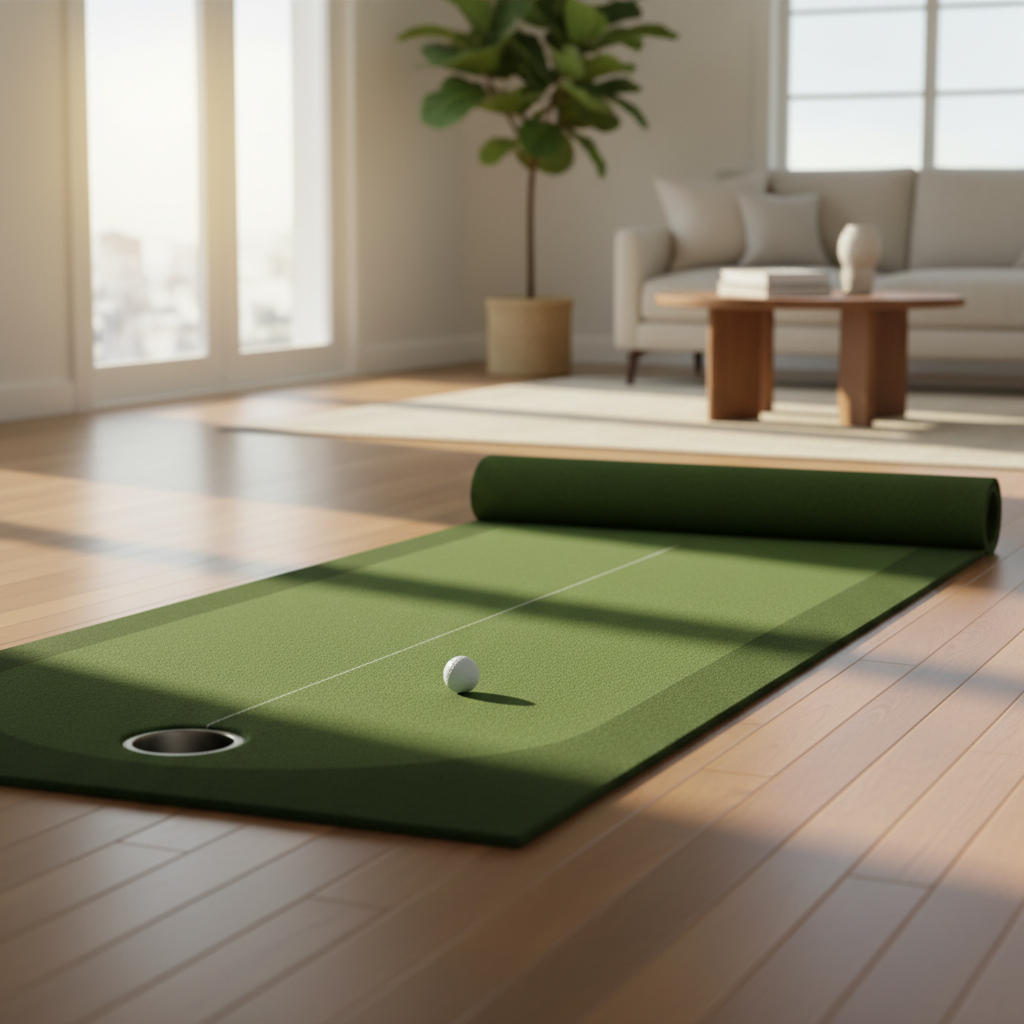
Look, I've got a full-blown simulator bay in my garage. We're talking impact screen, projector, a decent launch monitor. And for a long time, I just figured that was good enough for putting practice. "My sim does putting!" I'd tell myself, rolling a few virtual putts on a screen.
Mistake number one, folks. A big one.
If you're serious about improving your golf game, or even just keeping it sharp through the off-season, you need to be putting. And I mean real putting, with a real ball, on a real surface. Not just some pixels on a screen. My sim's putting module is fine for a quick measurement of speed and direction, but it's not going to teach you how to read a break or get the feel of a specific stimp.
I'm Mack, your 12-handicap golf tech guinea pig, and I've tried more indoor putting setups than my wife cares to count. From glorified doormats to rolls of high-end turf, I've tested them all to figure out what actually helps shave strokes. Because let's be honest, we all leave way too many out there on the green.
So, you've decided to get serious about your short game. Excellent. Let's talk about what's actually worth your hard-earned cash.
Indoor Putting Greens: Mack's Picks
Here's a quick rundown of some solid options across different budgets and needs. We'll dive into the nitty-gritty below.
| Product Category | Best For | Price Range | Mack's Take | Key Feature(s) |
|---|---|---|---|---|
| Budget/Portable | Casual practice, small spaces, travel | $50 - $150 | Great for consistency drills, not for realistic feel. | Compact, easy to store, decent roll. |
| Mid-Range/Versatile | Dedicated home practice, varied drills | $150 - $400 | Good balance of quality and features. My sweet spot for most golfers. | Multiple hole options, subtle breaks, better turf. |
| Premium/Realistic | Serious golfers, sim integration, high-end feel | $400 - $1,500+ | As close to a real green as you'll get indoors. Worth it if you're serious. | High-density turf, customizable size/shape, true roll. |
| Tech-Enabled | Data junkies, detailed feedback, game improvement | $200 - $1,000+ | Unlocks the "why" behind your misses. Essential for focused improvement. | Ball tracking, stroke analysis, gamification. |
Basic Mats: The PuttOut Slim and Pro Series
- Price: PuttOut Slim ($50-70), PuttOut Pro ($90-120)
- Dimensions: Slim (7.87 ft x 9.84 in), Pro (7.87 ft x 1.64 ft)
- Stimp: Around 10-11 feet
You want to get a feel for the ball rolling straight and consistently? This is your entry point. The PuttOut mats are probably the most ubiquitous indoor putting aid, and for good reason. They roll true for their price point, and they're easy to roll up and stash in a corner.
I started with the PuttOut Pro mat, paired with their Pressure Putt Trainer (which I still use, by the way – that thing is genius for giving you immediate feedback on pace). The Pro mat is wider than the Slim, which helps if you tend to wander a bit with your setup.
Mack's Take: For under a hundred bucks, you can't go wrong here. It's not going to replicate green speed perfectly, and it certainly won't give you any breaks, but it's fantastic for working on your stroke mechanics, alignment, and getting a consistent roll. I used mine religiously for straight putts before I moved to something bigger. This is the "putt during a TV show" option.
Mid-Range Versatility: Perfect Practice Putting Mat
- Price: $150 - $200 (various sizes)
- Dimensions: Original (9 ft 6 in x 15 in), XL (15 ft 6 in x 15 in)
- Stimp: Around 10-12 feet
This is where you start to get a bit more bang for your buck in terms of features and feel. The Perfect Practice mats are known for their auto ball return, which is a game-changer for high-rep practice. No more bending over after every putt. It comes with two holes – a regulation size and a smaller one for targeting, which is a great drill.
I jumped on one of these after realizing how much time I was wasting fetching balls. The surface feels a step up from the basic mats, and the heavier backing keeps it flatter. I really liked the target lines too, helping to train your eyes for a straight path.
Mack's Take: If you've got the space (the XL is a serious commitment at 15 feet), and you're looking for something that encourages more consistent practice sessions without breaking the bank, this is a solid choice. The auto return is a luxury that quickly becomes a necessity. It’s better than the basic mats for feel, but still a bit fast and doesn't offer much in the way of reading breaks. Think of it as a step up for stroke mechanics and pace control on straight putts.
Premium Experience: Big Moss Golf Putting Greens
- Price: $400 - $1,500+ (depending on size, model, and custom options)
- Dimensions: Highly variable, from 4x8 ft up to massive custom setups
- Stimp: Adjustable, typically 10-13 feet depending on model/brushing
Alright, now we're talking about serious putting practice. When I decided to really commit to my short game within my sim bay, I looked at Big Moss. These aren't just mats; they're designed to replicate the feel and challenge of a real green. They use high-density, professional-grade turf.
What sets Big Moss apart is the quality of the roll and the ability to create subtle breaks. They often come with shims or foam wedges you can place underneath to simulate uphill, downhill, and sidehill putts. This is HUGE. Suddenly, you're not just hitting a straight putt; you're reading a putt, which is half the battle on the course. They also offer different hole configurations and flagsticks.
I went with a 6x10 ft Big Moss green for a corner of my garage. It's big enough to give me a decent length putt and allows me to work on different angles. The ability to introduce subtle breaks by just moving a foam wedge under the mat was a revelation. My putting practice immediately became more engaging and realistic.
Mack's Take: If you're serious about translating your indoor practice to the course, and you have the budget and space, a Big Moss (or similar high-quality turf like Pro Putt Systems) is a game-changer. It's an investment, but it's the closest you'll get to a real green indoors. This is particularly good if you're integrating it into a sim room and want a dedicated, realistic putting zone that isn't dependent on the launch monitor. Just remember, these are heavier and less portable. Once it's down, it's generally staying down.
Tech-Enabled Practice: ExPutt putting simulator
- Price: ExPutt RG ($300-400), ExPutt R ($600-700)
- Dimensions: Requires about 3-4 feet in front of a TV/monitor, plus space for putting mat (usually included, ~10 ft x 2 ft)
- Subscription Fees: None for basic functionality. Some advanced features or course packs might be extra, but the core data is free.
- Stimp: Customizable in software
This is where the data geeks (like me!) get excited. You mentioned "data" in the community context, and this is exactly what an ExPutt delivers for putting. It's not just a mat; it's a full-on putting simulator that tracks your putter path, face angle, impact point, and ball speed/direction. It projects the green onto your TV, so you get visual feedback on breaks, pace, and where your ball actually goes.
I picked up an ExPutt RG (the entry-level one) because I wanted to understand why my putts were missing, not just that they were missing. My simulator's putting module gives me some numbers, but the ExPutt focuses entirely on putting and provides much more granular data. It overlays your putter path and face angle directly on the screen, letting you see your stroke in real-time. It's like having a putting coach looking over your shoulder.
Mack's Take: If you're a data-driven golfer who wants to dissect their putting stroke and practice reading greens with visual feedback, the ExPutt is a fantastic tool. It offers game modes, practice modes with specific drills, and even virtual courses. It integrates well with a TV setup in a garage or living room. The mat quality isn't Big Moss level, but it's decent, and the tech is the real star here. No ongoing subscription fees for the core features is a huge plus. This is an excellent addition to a sim bay if you want dedicated putting data that your main launch monitor might not provide in as much detail.
Who Should NOT Buy This
Alright, let's get real. Not every shiny new golf gadget is for everyone, and I've made my share of mistakes here.
1. Don't Buy an "Automatic Ball Return" Mat (Unless it's Perfect Practice Quality or Better)
I'm talking about those cheap, flimsy plastic ramps that claim to return your ball. They're usually paired with a thin, inconsistent felt mat. The ball often gets stuck, or bounces off the side, or the ramp itself moves. You'll spend more time adjusting it or retrieving balls than actually putting. I bought one for $30 once. It lasted a week before it was in the donation bin. Stick to the Perfect Practice if auto-return is a must, or just accept retrieving the ball for higher quality mats.
2. Don't Buy a Mat That's Too Short (Under 6 Feet)
Unless you literally only want to practice 3-footers (and even then, you need a decent run-out), a mat under 6 feet is mostly useless. Most of your practice putts should be in the 6-20 foot range to work on pace control. A short mat only allows for tap-ins, which doesn't help your game. My first mat was a 4-footer. It was great for building confidence on gimmes, terrible for anything else.
3. Don't Buy a Mat with Exaggerated "Breaks" or Ridges
Some mats are designed with built-in, unchangeable hills and valleys to simulate breaks. The problem? They're often completely unrealistic and don't teach you how to read a green. They teach you how to hit the ball along that specific mat's predetermined path. You want a flat, true-rolling surface, and if you want breaks, use shims underneath (like with Big Moss) or a tech solution like ExPutt that projects them. I had one with a huge, fixed left-to-right break; it just reinforced bad habits for real greens.